
How to Search Hoke County Court Records
The main online path for Hoke County Court records is the North Carolina eCourts Portal. Hoke County joined eCourts in October 2024, so public case search, hearing dates, payments, Guide & File, and document access now route through the statewide Tyler-hosted system when allowed. Smart Search is the broad case lookup. Search Hearings is the calendar lookup. Make Payments handles eligible citations and costs. NC Judgment Search is the judgment-index tool.
The North Carolina eCourts Portal landing page groups Hoke County Court record search, hearings, payments, and judgment tools in one public entry point.
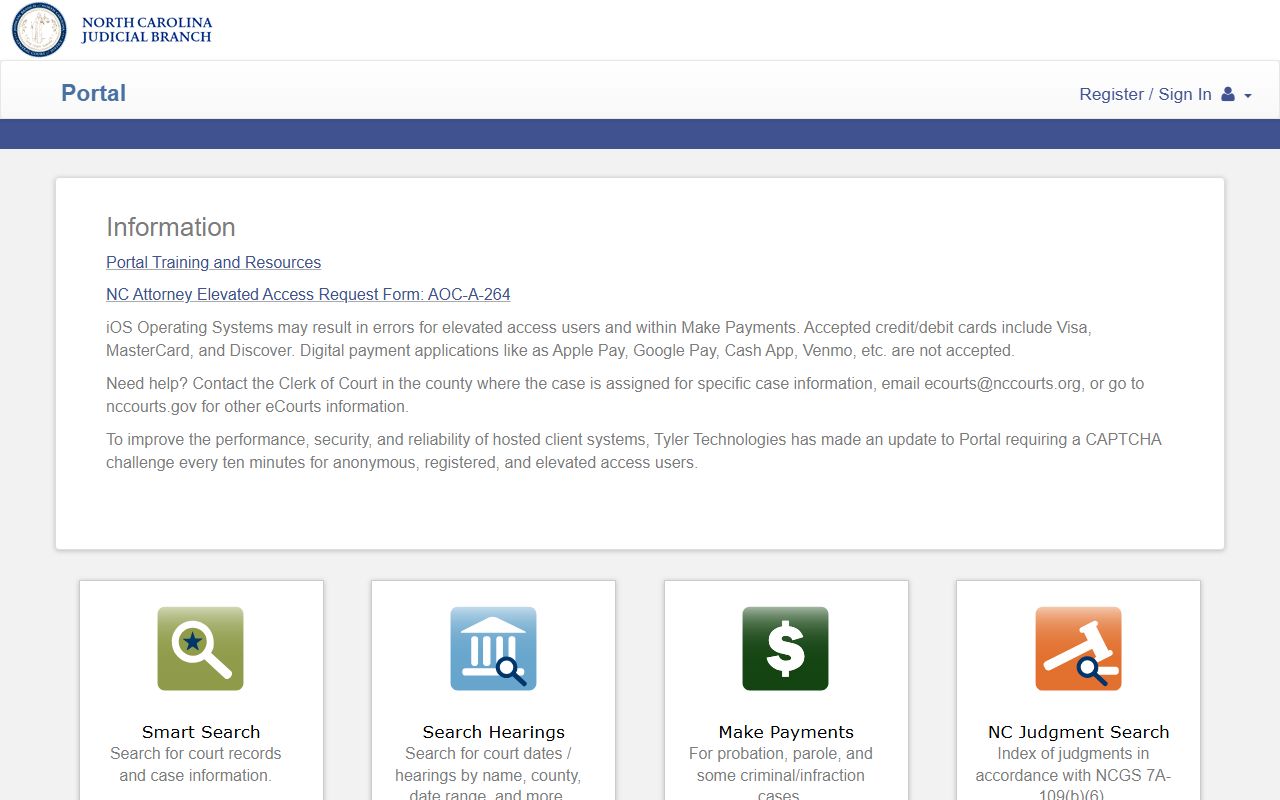
The Portal landing page separates case lookup, hearing search, payment lookup, and judgment index search.
The NC Judicial Branch Hoke County landing page is the official local starting point for court services and district information.
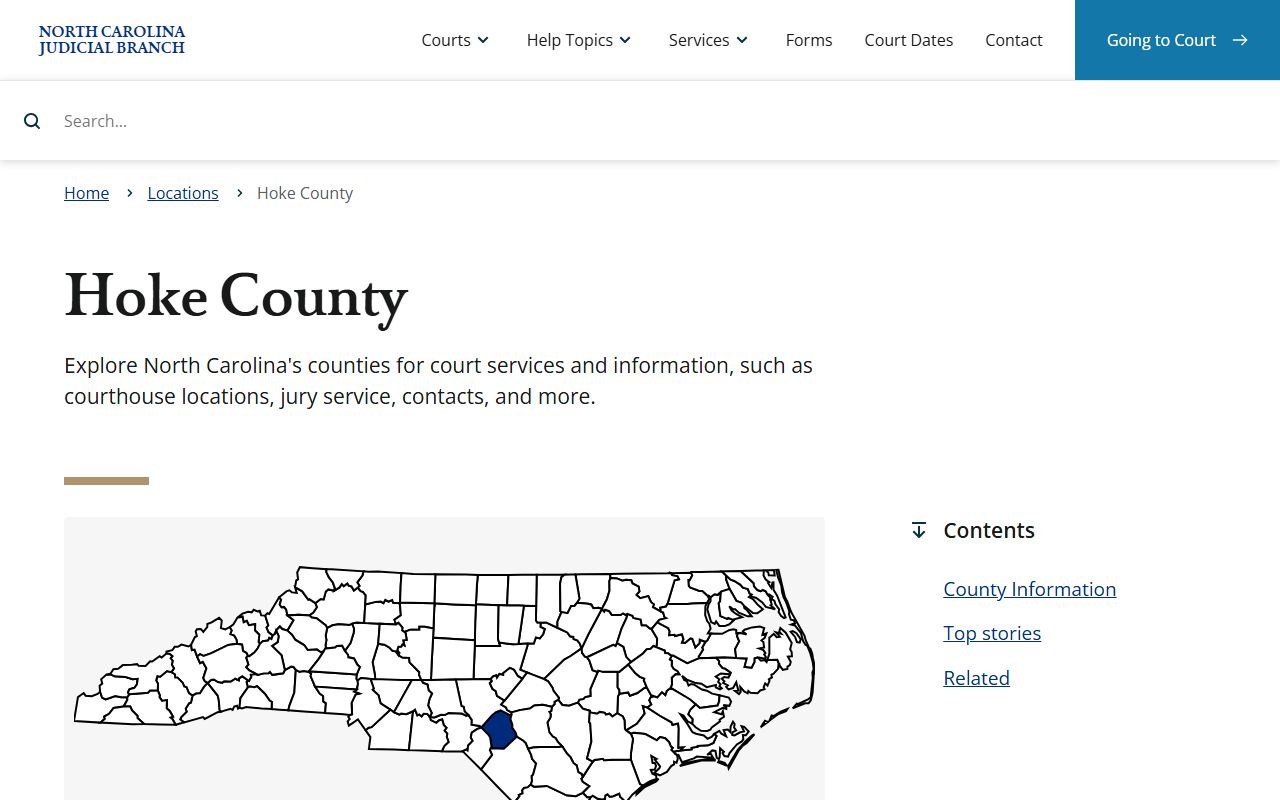
That local court page ties Hoke County access to eCourts services and courthouse contacts.
- Open eCourts Portal and choose Smart Search, Search Hearings, Make Payments, or NC Judgment Search.
- For Smart Search, enter a case number or a party name in Last, First Middle Suffix format. Use the Hoke County location filter when it is available.
- Use advanced filters when a name is common. Case type, status, file dates, and party criteria can narrow results.
- Review the case summary, register of actions, hearings, dispositions, financial information, and public documents.
- Contact the Clerk of Superior Court for certified copies, paper files, sealed-file questions, or missing records.
Note: Portal registration does not by itself create elevated access to restricted Hoke County Court records.
Hoke County Court Search Fields
Smart Search works best when treated like a court index. Official Portal guidance says record-number wildcard searches need at least four characters. Name wildcard searches need at least three last-name characters plus an asterisk and at least one first-name character plus an asterisk. Business searches use Advanced Filtering Options and the Business Name filter.
The eCourts Make Payments screen is separate from Smart Search and is used only for eligible payable court debt.
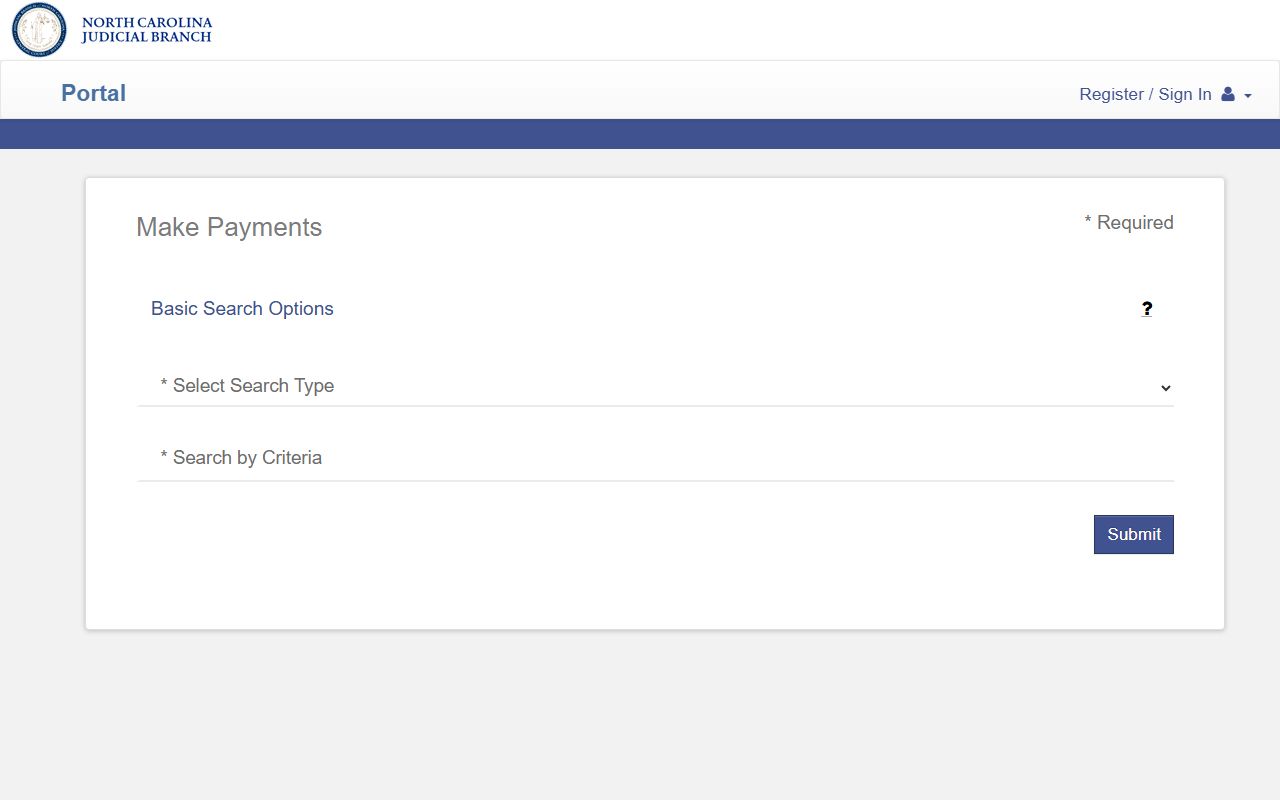
Payment search is useful for citations and some criminal or infraction costs, but it does not replace the full case summary in Smart Search.
| Field Label | Type | Required | Format Notes |
|---|---|---|---|
| Record Number or Name | Text | Yes for basic search | Use case number or Last, First Middle Suffix name format. |
| Filter by Location | Dropdown/list | Optional | Select Hoke County to avoid statewide matches. |
| Filter by Search Type | Dropdown | Optional | Select Business Name for a company or entity party. |
| Date of Birth From / To | Date | Optional | Useful for party-name searches where public display allows it. |
| Case Type / Case Status | Dropdowns | Optional | Narrows criminal, civil, family, estates, or other case groups. |
| File Date Start / End | Date | Optional | Limits results by filing period. |
Hoke County Court Structure
North Carolina uses a unified General Court of Justice. Hoke County trial work is handled through Superior Court and District Court, both served by the elected Clerk of Superior Court. Hoke County is in Prosecutorial District 29, Superior Court District 29, and District Court District 29 with Moore County. The clerk maintains trial-court records and acts as probate judge for estates, guardianships, and related special proceedings.
Case flow depends on case type. Magistrates handle initial appearances, warrants, small claims, and after-hours duties. District Court handles most misdemeanors, infractions, traffic matters, domestic cases, juvenile matters, and many lower-level civil matters. Superior Court handles felony trials, larger civil cases, many appeals, and will caveats that move beyond clerk probate authority.
| Court or Office | Primary Role | Common Hoke County Records |
|---|---|---|
| District Court | Misdemeanors, traffic, domestic, juvenile, small claims appeals | Citations, lower-level criminal cases, custody, support, protective orders |
| Superior Court | Felonies, larger civil cases, appeals, trials | Felony case files, civil judgments, trial orders, appeals from District Court |
| Clerk of Superior Court | Records office and probate judge | Civil, criminal, estates, special proceedings, copies, public terminals |
| Magistrates | Initial judicial duties within District Court | Warrants, first appearances, small claims, summary ejectment activity |
Appeal path: Magistrate or District Court matter › Superior Court review where allowed › North Carolina Court of Appeals › Supreme Court of North Carolina.
Hoke County Court Contact
The main courthouse for Hoke County Court records is the Hoke County Courthouse in downtown Raeford. The building houses the Clerk of Superior Court and supports District Court, Superior Court, criminal, civil, family, traffic, special proceeding, and estates/probate work. The NC Judicial Branch lists wheelchair access, an elevator, baby changing station, and vending machines. The public entrance is on E. Edinborough Avenue.
The official Hoke County Courthouse page lists the courthouse address, hours, mailing address, phone, and facilities.
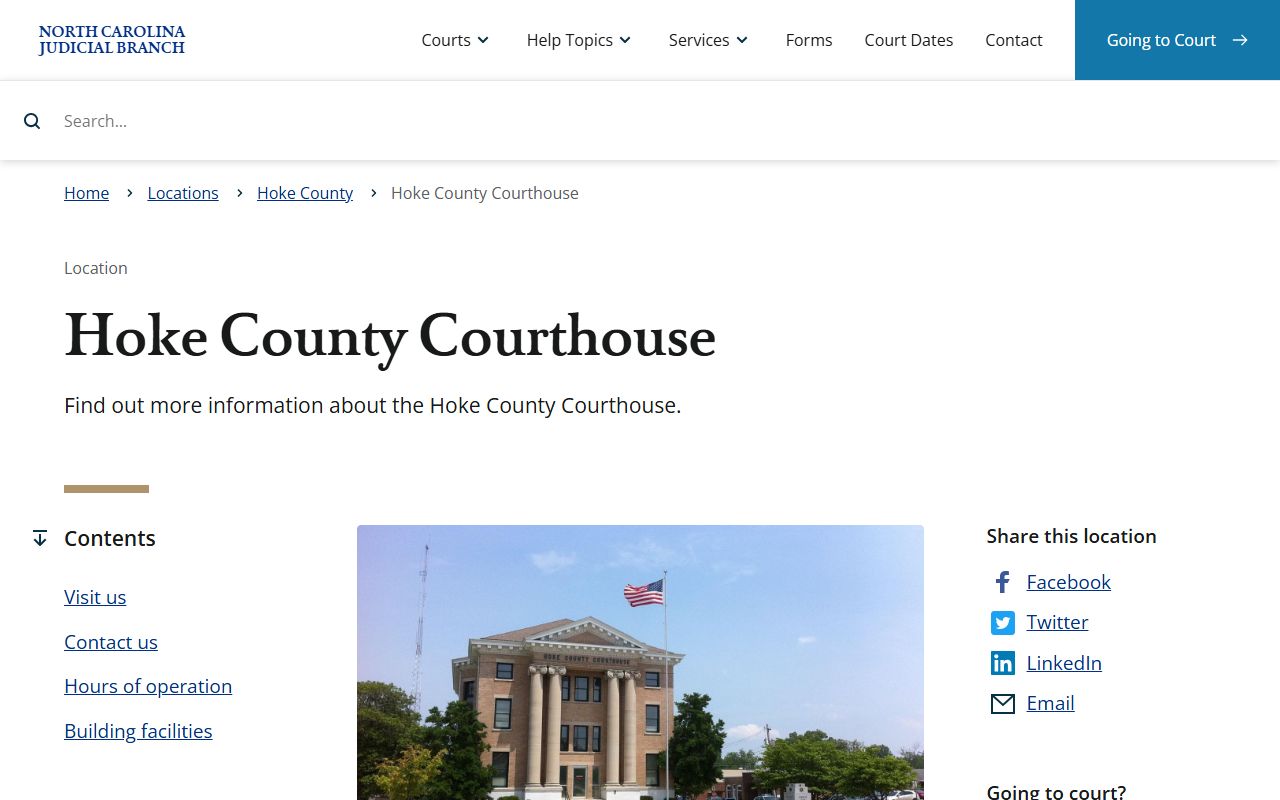
The courthouse listing is the source for hours, accessibility notes, and service updates.
The Hoke County court contact directory lists clerk, judge, district attorney, magistrate, mediation, arbitration, and Guardian ad Litem phone paths.
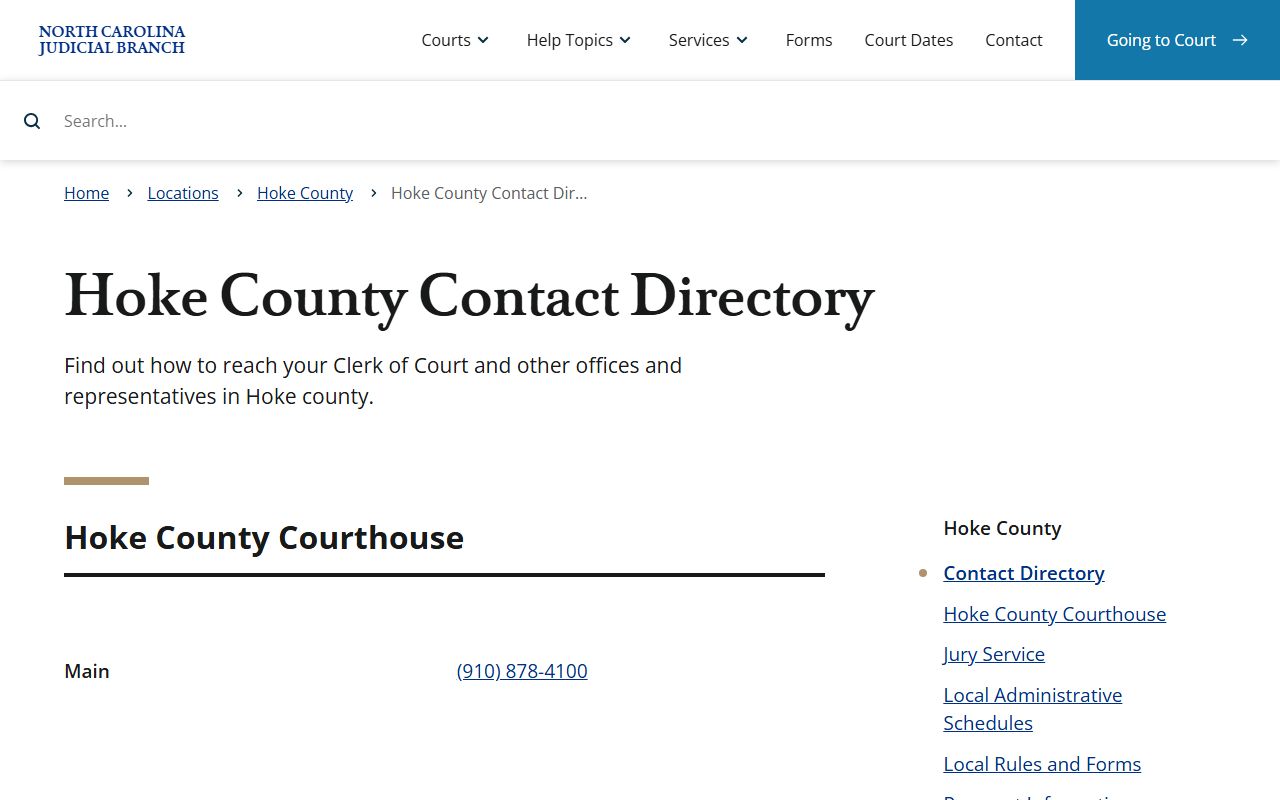
The directory routes questions to judges, magistrates, the District Attorney, mediation, or another court-connected office.
Hoke County Courthouse
304 N Main St
Raeford, NC 28376
(910) 878-4100
Monday-Friday, 8:30 a.m.-5:00 p.m.
Clerk of Superior Court
304 N Main Street
Raeford, NC 28376
(910) 878-4100
Fax: (910) 878-4101
Hoke County Detention Center
125 E. Edinborough Avenue
Raeford, NC 28376
(910) 875-5113
Inmate information, charges, and bond conditions
Hoke County Clerk Records
The Hoke County Clerk of Superior Court is Evelyn McLeod. North Carolina clerks keep District Court and Superior Court records and perform judicial functions for probate, guardianships, foreclosures, name changes, adoptions where allowed, and post-judgment remedies. The clerk is the main fallback when Portal does not show a file, when a certified copy is required, or when a paper record must be inspected in Hoke County.
The Hoke Clerk of Superior Court page adds local payment and service rules that matter before a courthouse visit.
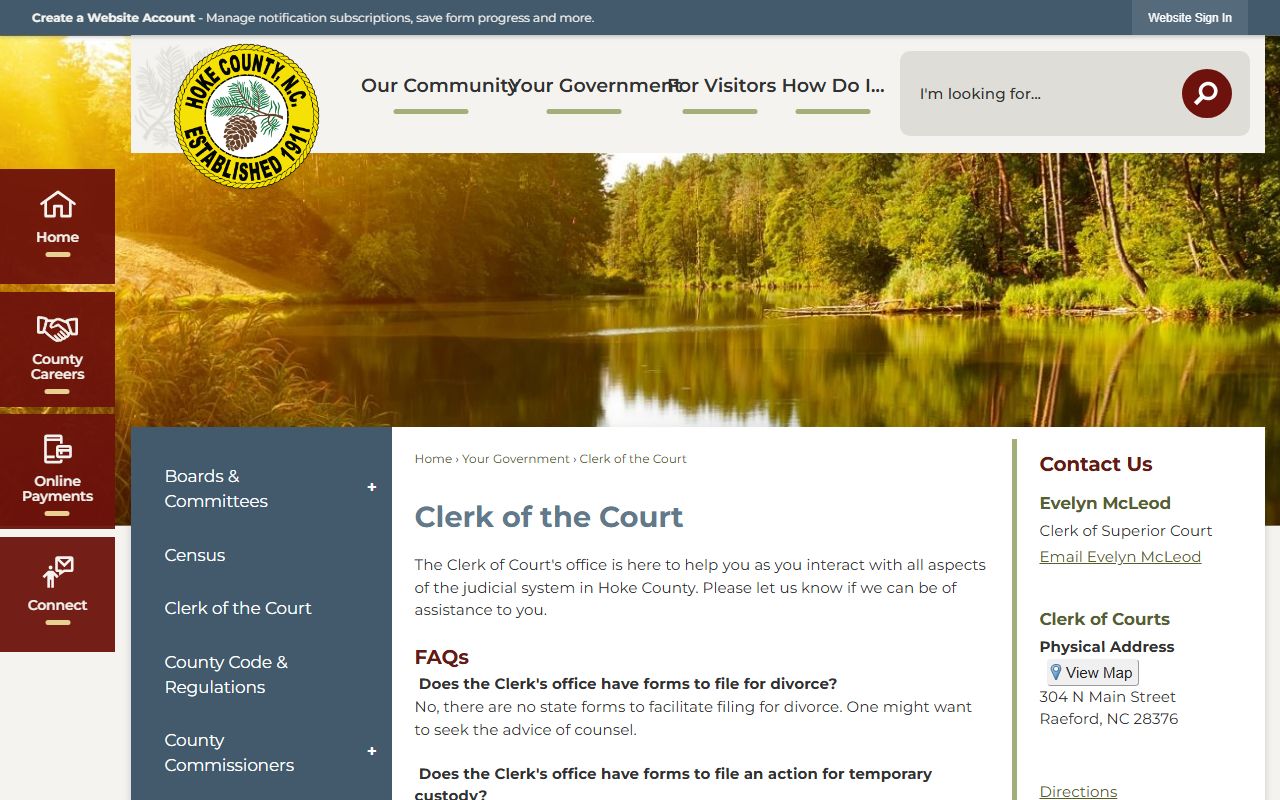
The clerk page lists payment limits, hours, contacts, and record-question routing.
| Request or Payment | Hoke County Rule |
|---|---|
| Counter payment | Cash or certified funds only. No debit cards, credit cards, or personal checks. |
| Mail payment | Money order or certified check payable to Hoke County Clerk of Superior Court. No cash or personal checks. |
| Court copies | Current North Carolina miscellaneous fee schedules control plain and certified copy fees. |
| Civil, criminal, estates, and special proceedings costs | Use the current 2026 NC Judicial Branch cost schedules before filing or requesting service. |
| Online payments | Eligible matters may be paid online by Visa, MasterCard, or Discover through court payment tools. |
Hoke County Court Record Types
Hoke County Court records include criminal cases, civil actions, family and divorce cases, probate and estates, traffic citations, small claims, special proceedings, judgments, and hearings. Criminal files can show charges, pleas, dispositions, sentencing, restitution, costs, and bond conditions. Civil records may show complaints, summonses, answers, motions, orders, judgments, service returns, mediation, arbitration, and appeals.
Marriage records are different. Hoke County marriage licenses and recorded marriage certificates are Register of Deeds records, not clerk case files. Divorce judgments are court records and are obtained from the clerk where the divorce was granted. Estate and probate work is handled by the Clerk of Superior Court acting as ex officio Judge of Probate. More probate detail belongs with Hoke County probate records.
- Docket or Register of Actions
- The chronological list of filings, hearings, orders, payments, and case events.
- Disposition
- The recorded outcome of a charge, claim, or case event.
- Judgment
- A final or enforceable court decision that may create duties, money owed, or case closure.
- Expunction
- A statutory process that removes qualifying records from ordinary public access.
- Caveat
- A formal challenge to the validity of a will that may move to Superior Court.
Hoke County Court Access Laws
North Carolina public access rules require more nuance than a single open-records rule. State law broadly defines public records for public agencies, but court files follow Judicial Branch statutes and court access rules. For Hoke County Court records, public case information starts in Portal, copies and older files route to the clerk, and restricted case types remain limited even if a search term matches.
Key North Carolina statutes:
N.C.G.S. 132-1 defines public records broadly, while court case access follows specific Judicial Branch rules.
N.C.G.S. 7A-109 requires clerks to keep records and indexes for civil, criminal, special proceeding, estate, and judgment records.
Chapter 15A, Article 5 controls many criminal expunction paths that can remove eligible records from public view.
N.C.G.S. 7B-3000 restricts access to many juvenile court records.
N.C.G.S. 48-9-102 keeps adoption records confidential except through statutory procedures.
Restricted Hoke County Court Records
Restricted records include juvenile delinquency, abuse, neglect, dependency, adoption files, many mental health proceedings, sealed materials, and expunged matters. Public users should not expect those records in anonymous Portal results. Personal identifiers, protected addresses, minor names, medical information, and some victim information may be redacted or hidden.
Search warrants may be unavailable or sealed before execution and return. Expunction requires a qualifying statute, a proper petition, notice or response steps, and a court order before agencies remove qualifying information from ordinary public access.
Note: A missing result can mean no record, a spelling issue, a location filter issue, delayed entry, or a legally restricted file.
Hoke County Hearings and Judgments
Hearing dates are searched through Portal Search Hearings rather than the full Smart Search path. Search criteria can include case number, party name, business name, attorney name, bar number, judicial officer, or courtroom. Visible hearing categories include civil, criminal, family, and probate or mental health. Common names should be narrowed with the Hoke County location filter.
Judgment research is separate. NC Judgment Search indexes judgments entered in the Judicial Branch database under N.C.G.S. 7A-109(b)(6). Results may show case number, disposition status, index date, parties, and judgment comments, but full case context belongs in Smart Search or the clerk's file.
Hoke County Sheriff and Jail Records
The Hoke County Sheriff's Office is at 429 E. Central Avenue in Raeford, with the main office listed at (910) 875-5111. The Hoke County Detention Center is at 125 E. Edinborough Avenue, with inmate information at (910) 875-5113 from 8 a.m. to 5 p.m. Jail staff can provide public charge and bond-condition information, but the jail does not set bond, change court dates, render verdicts, or decide punishment.
The county website did not show an official browser-based jail roster in the research file. The Hoke County Sheriff's Office mobile app advertises inmate search, sex offender location, tips, gun permitting or CCW information, and public safety news. Full jail lookup detail belongs with Hoke County inmate records.
Hoke County Marriage Divorce Probate
Marriage, divorce, and probate records split across offices in Hoke County. Marriage licenses are handled by the Hoke County Register of Deeds at 113 Campus Avenue, not by the court clerk. The local online marriage application is a pre-application. Both applicants still must appear in person, provide required documents, and complete the oath and signatures. A North Carolina marriage license is valid for 60 days.
Divorce records are court records. Divorce judgments come from the Clerk of Superior Court where the divorce was granted. Hoke's local clerk FAQ says the office does not provide divorce forms or temporary custody forms as a form-preparation service, while statewide Judicial Branch materials provide a Divorce Packet and Guide & File for some absolute divorce filings.
Hoke County Traffic Court Records
Traffic citations in Hoke County generally route through District Court rather than a separate municipal court. A traffic court record is not the same as an NCDMV driving record. The court file can show citation number, case number, charge, court date, disposition, costs, payment status, and failure-to-appear events. A DMV record shows license status, convictions, wreck information, points, and suspensions.
Hoke payment channels differ by method. Portal online payments accept Visa, MasterCard, and Discover for eligible costs and fees. The Portal does not accept Apple Pay, Google Pay, Cash App, or Venmo. Hoke clerk counter payments are cash or certified funds only. Mail payments must be money order or certified check payable to Hoke County Clerk of Superior Court.
Hoke County Court Updates
Hoke County Court access changed when eCourts went live for Hoke and ten other counties on October 14, 2024. Older advice that relies only on courthouse terminals is incomplete because Hoke now uses Portal for public case search, hearing search, electronic filing, payments, Guide & File, and document access where allowed. Public terminals and clerk help still matter for older records and certified copies.
Hoke County's historic courthouse was built in 1912, designed by Milburn, Heister & Company, built by J. A. Jones, and listed on the National Register of Historic Places in 1979. Modern operations use controlled public, staff, and detainee circulation, which explains the public entrance and screening rules.
The NC Judicial Branch Portal training page explains Smart Search, hearing search, payment tools, judgment search, registration, and access limits.
The training materials explain wildcard rules, business-name searches, case-number format, and elevated-access limits.
Hoke County Court Records FAQ
Can Hoke County Court records be searched online? Yes. eCourts Portal is the official online path for public case information, hearing dates, eligible payments, and judgment-index research. The clerk remains the fallback for certified copies and paper files.
Who keeps Hoke County court files? The Clerk of Superior Court keeps District Court and Superior Court records and handles probate functions as ex officio Judge of Probate.
Are marriage records at the courthouse? Marriage licenses and certificates are Register of Deeds records. Divorce judgments are requested from the Clerk of Superior Court where the divorce was granted.
Is there a Hoke County warrant list online? No official public browser-based active warrant list was located. Warrant questions route through Portal case events, the clerk, magistrates, sheriff, jail phone line, or counsel.